

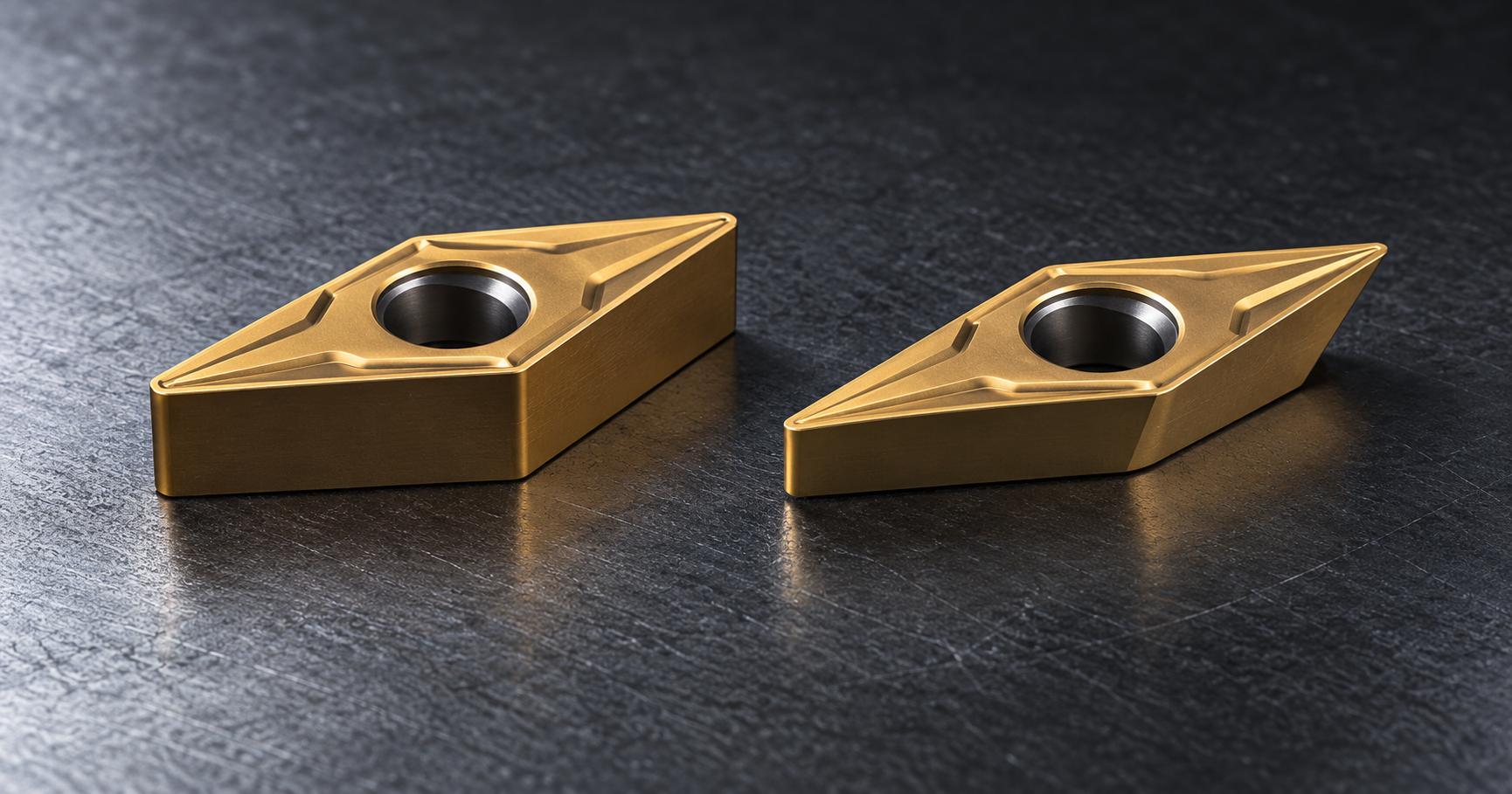
VNMG and VBMT are both 35° rhombic turning inserts designed for profiling, contouring, and access around detailed part features. Their main difference is clearance geometry: a VNMG has 0° clearance and is normally a double-sided negative insert with four usable cutting edges, while a VBMT has 5° clearance and is normally a single-sided positive insert with two usable edges. In practical terms, VNMG offers greater edge support and better edge economy in a rigid setup; VBMT reduces cutting forces and is often the better choice for finishing, slender parts, thin walls, boring, and smaller machines. Despite their shared V shape, they require different holder pockets and are not interchangeable.
Key Takeaways
- VNMG and VBMT share a 35° rhombic shape, but VNMG has 0° clearance while VBMT has 5° clearance.
- VNMG is double-sided with typically four usable edges; VBMT is single-sided with typically two.
- Choose VNMG for stable external turning and semi-finishing when edge support and cost per edge matter.
- Choose VBMT for lower cutting forces, fine finishing, thin-wall parts, slender shafts, and small-part or Swiss-type machining.
- Compare cost per finished component—not only price per insert—because grade, coating, chipbreaker, tool life, and scrap risk can outweigh the purchase price.
1. What Do the VNMG and VBMT Codes Mean?
Under the ISO 1832 designation system, the first four letters describe the insert’s shape, normal clearance, tolerance class, and type. The second letter specifies clearance angle, not rake angle: the effective rake still depends on the chipbreaker, edge preparation, and holder geometry. Numbers such as 160404 then identify nominal cutting-edge length, thickness, and nose radius; in this example, the final 04 indicates a 0.4 mm nose radius.
| Position | VNMG | VBMT | Meaning |
|---|---|---|---|
| 1 | V | V | 35° rhombic insert shape |
| 2 | N | B | 0° clearance for N; 5° clearance for B |
| 3 | M | M | M tolerance class |
| 4 | G | T | G: cylindrical hole and double-sided chipbreaker; T: countersunk hole and single-sided chipbreaker |
Because the clearance and mounting features differ, a VNMG160404 should not be installed in a holder designed for VBMT160404, or vice versa. Always match the complete insert designation to the holder manufacturer’s pocket specification.
2. VNMG vs. VBMT Cost Comparison
The following figures are a public price snapshot retrieved on October 23, 2026, not a 2027 quotation. They are representative listings, not guaranteed delivered prices. Taxes, freight, discounts, geometry, and quantity can change the result.
| Segment | Representative listing | Public price | Quantity or MOQ |
|---|---|---|---|
| Premium international | Sandvik Coromant VNMG160404-QM 1105 | US$27.81 each web price | Sold in multiples of 10 |
| Premium international | Sumitomo VNMG160404N-GU AC530U | US$85.64 | Pack of 10 |
| Established Chinese brand | ZCC-CT VBMT160404-53 YBC251 | US$85.56 | Pack of 10 |
| Value tooling | Haas VNMG160404-HVB HCP10C | US$69.95 | Pack of 10 |
| Value tooling | Haas VBMT160404-HFP HTS25 | US$16.95 | Pack of 5 |
| Chinese-made marketplace listing | VNMG160404/VNMG160408 cermet insert | US$1.38 each | 10-piece MOQ |
VNMG can have an economic advantage because four usable edges spread the price across twice as many indexes as a typical two-edge VBMT. A US$2 VNMG costs a theoretical US$0.50 per edge; a US$2 VBMT costs US$1 per edge. This is only a starting point: a VBMT that prevents chatter, holds size, or produces more parts per edge may still cost less per finished component.
Premium brands such as Sandvik Coromant, Kennametal, Iscar, Tungaloy, Mitsubishi Materials, Sumitomo, Kyocera, and Seco charge for developed grade systems, consistency, distribution, and technical support. Chinese manufacturers can offer lower prices, volume tiers, OEM supply, and customization. Compare the same ISO size, substrate, PVD or CVD coating, chipbreaker, and material group. See CarbideMatch’s general turning inserts when benchmarking alternatives.
3. VNMG vs. VBMT Applications
| Application or condition | Better starting choice | Why |
|---|---|---|
| Stable external turning | VNMG | Supported double-sided geometry and four-edge economy |
| Semi-finishing in a rigid setup | VNMG | Good balance of access, edge support, and indexing cost |
| Fine finishing | VBMT | Positive clearance helps reduce cutting forces |
| Thin-wall components | VBMT | Lower forces can reduce deflection and chatter risk |
| Slender shafts or long overhangs | VBMT | Lighter cutting action suits less-rigid conditions |
| Internal turning and small bores | VBMT | Clearance and lower forces are useful where rigidity is limited |
| Swiss-type and small-part machining | VBMT | Well suited to low-power machines and delicate features |
| Profiling and contouring | Either | Both offer a narrow 35° point; select by rigidity and load |
| Interrupted cuts | Application-dependent | Grade, edge preparation, holder stability, and interruption severity matter |
VNMG inserts are profiling, finishing, and medium-cutting tools—not automatically heavy-roughing inserts. Their 35° point is less robust than wider CNMG or WNMG shapes. VBMT inserts favor light cutting and access, but chipbreaker and grade still determine suitability for ISO P, M, K, N, S, or H materials.
4. Frequently Asked Questions
Is VNMG stronger than VBMT?
VNMG generally has better edge support because its 0° clearance geometry is double-sided. Its 35° point is still less robust than larger included-angle inserts, while grade, nose radius, edge preparation, and rigidity remain important.
Which insert gives a better surface finish?
VBMT is often the better starting choice for finishing because it cuts with lower forces. VNMG can also finish effectively in a stable setup when the chipbreaker, nose radius, feed, and grade are correctly selected.
Can VNMG and VBMT use the same toolholder?
No. Their clearance angles and hole or clamping features require different pockets. Similar size codes do not make them interchangeable.
Is VNMG always cheaper than VBMT?
Not per insert. VNMG often has a lower theoretical cost per edge because it normally provides four usable edges instead of two. Actual economy depends on usable tool life, cycle time, part quality, and failure rate.
Can VBMT be used for roughing?
VBMT can handle light or moderate stock removal when the manufacturer’s grade and chipbreaker permit it, but it is not the default choice for heavy roughing or severe interrupted cuts.
Conclusion
Choose VNMG when the machine, holder, and workpiece are rigid and you want supported geometry with strong cost-per-edge potential. Choose VBMT when low cutting force, surface finish, small features, thin walls, or limited machine power matters more. Final selection should account for workpiece material, depth of cut, feed, nose radius, chipbreaker, carbide grade, coating, tool overhang, and holder compatibility.
For a matched recommendation, send CarbideMatch your current insert code, workpiece material, depth of cut, feed rate, holder model, and a wear photo through the request-a-quote form.
Sources
- Ingersoll Cutting Tools — Turning Insert Nomenclature, retrieved 2026-10-24.
- Iscar — ISO Insert Nomenclature and Clearance Angles, retrieved 2026-10-24.
- Sandvik Coromant — Latest Cutting Tools Catalog, retrieved 2026-10-24.
- Grainger — Sandvik Coromant VNMG160404-QM 1105, retrieved 2026-10-24.
- Haas Tooling Price List, retrieved 2026-10-24.
- Made-in-China — VNMG160404/VNMG160408 Cermet Insert, retrieved 2026-10-24.