

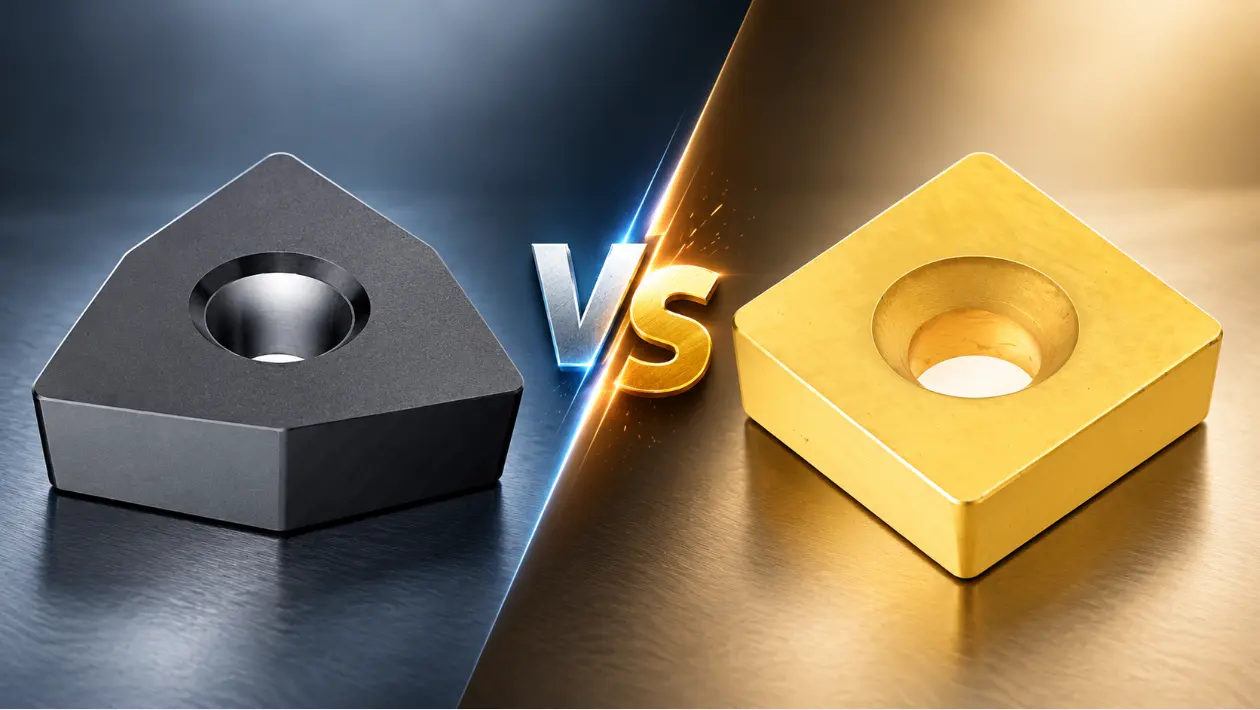
When comparing ceramic and carbide hardness, buyers often find that datasheet numbers do not predict which edge will actually survive the cut. Room-temperature hardness ratings cannot show how a grade will hold up once extreme cutting heat and heavy mechanical loads hit the tool edge at the same time.
Hardness and toughness must be read together because ceramic holds its edge at higher temperatures, while carbide absorbs shock more safely. Understanding alumina ceramics, cobalt binder content, and interrupted cut behavior helps buyers avoid a material swap that fixes wear but creates chipping.
Key Takeaways
- Hardness Winner: Ceramic cutting inserts generally exceed cemented carbide in hardness, especially after cutting temperatures rise substantially.
- Toughness Winner: Carbide resists impact, vibration, interrupted cuts, and sudden load changes better than most ceramic grades.
- Grade Variation: Ceramic family, carbide grain size, cobalt content, coating, and edge preparation can change the practical result.
- Buying Rule: Choose ceramic for stable high-temperature cutting and carbide when setup variation or mechanical shock controls tool life.
What Is Harder, Ceramic or Carbide?
Ceramic cutting inserts are generally harder than cemented carbide inserts and retain more of that hardness at high cutting temperatures. ISCAR places ceramics between cemented carbide and superhard materials such as CBN and PCD on the hardness-toughness spectrum. It also states that ceramics have considerably higher hot hardness than cemented carbide (FAQ: Main Properties of Ceramics, ISCAR). The answer applies to cutting-tool material families, not every possible grade measured under identical test conditions.
| Property | Ceramic insert | Carbide insert | Purchasing implication |
|---|---|---|---|
| Room-temperature hardness | Usually higher, but varies by ceramic family | High, with a broad grade range | Compare actual grade data rather than material names alone |
| Hot hardness | Retains hardness well at severe cutting temperatures | Loses useful strength sooner as temperature rises | Ceramic can support much higher speed in suitable cuts |
| Fracture toughness | Lower in most grades | Higher because the metallic binder arrests cracks | Carbide tolerates shock and unstable engagement better |
| Plastic deformation resistance | Very high at elevated temperature | Depends on substrate, coating, and heat load | Ceramic resists edge softening in hot cuts |
| Thermal shock tolerance | Often limited; silicon nitride families perform better | Usually more forgiving | Coolant delivery and cut entry matter more with ceramic |
| Application range | Narrower and more condition-sensitive | Broad across materials and operations | Carbide is the safer default when process details are uncertain |
Harder does not mean stronger in every direction. Ceramic resists indentation, abrasive wear, and high-temperature deformation, but it can crack when a load changes suddenly. Cemented carbide combines hard tungsten carbide particles with a metallic binder, usually cobalt. That binder lowers maximum hardness but improves resistance to crack growth. Buyers should therefore ask which failure mode limits the current operation before treating ceramic as an upgrade.
Hardness and Toughness Measure Different Risks
Hardness describes resistance to indentation, scratching, abrasive wear, and plastic deformation. Toughness describes the energy a material can absorb before a crack grows into a fracture. A cutting edge needs both properties, but no insert material maximizes both. Ceramic favors hardness and thermal stability. Cemented carbide gives up some hardness to gain crack resistance and a wider operating window.
Carbide properties also move within the same material family. ISCAR explains that increasing cobalt content makes cemented carbide tougher but less hard, while larger tungsten carbide grains create the same general shift (Cemented Carbides, ISCAR). Ceramic families differ as well. Alumina emphasizes hardness and chemical stability. Silicon nitride improves toughness and thermal-shock resistance. SiAlON and silicon-carbide-whisker reinforcement adjust the balance for heat-resistant alloys and demanding cuts. This variation explains why published numbers can appear to conflict. Vickers hardness depends on test load, material composition, grain structure, binder content, and specimen condition. CERATIZIT publishes cemented-carbide grades spanning roughly 800 to 2,200 HV30, while ISCAR lists its IW7 whisker ceramic at 2,100 HV. Those figures overlap, but they do not prove that the two tested products behave alike in a cut (Machining Cemented Carbide, CERATIZIT; IW7 Whisker Ceramic Grade, ISCAR). Test method and application behavior must stay attached to the number.
How the Trade-Off Changes Insert Performance
The hardness advantage becomes useful when cutting heat would soften or deform a carbide edge. Ceramic grades can maintain a cutting edge at speeds that create a hot, plasticized chip. Their lower toughness becomes the limiting factor when the insert strikes scale, crosses a keyway, chatters, or enters the workpiece abruptly. Carbide operates at lower speed in many of these jobs but survives more mechanical abuse.
| Cutting condition | Ceramic behavior | Carbide behavior | Better starting choice |
|---|---|---|---|
| Continuous cut on hardened steel | High wear resistance and hot hardness | More forgiving but may wear faster at elevated speed | Ceramic when the machine and part are rigid |
| Heavy interrupted turning | Edge may chip or fracture | Higher crack resistance handles impact better | Carbide, or CBN where the application supports it |
| High-speed cast-iron machining | Alumina or silicon nitride can run efficiently | Broadly usable at lower cutting speed | Ceramic for stable production; carbide for uncertain stock |
| Nickel-superalloy roughing | SiAlON or whisker ceramic uses high heat productively | Tougher but speed and wear may limit output | Ceramic after a controlled application trial |
| Flexible workpiece or long overhang | Vibration raises fracture risk | Better tolerance for deflection and load variation | Carbide |
| Variable batch work | Narrow grade window increases setup risk | Wider application range simplifies purchasing | Carbide |
Sandvik’s heat-resistant-superalloy guidance describes ceramic grades as highly temperature resistant but low in toughness. It recommends strong insert shapes, controlled engagement, and an entering angle near 45 degrees to reduce notch damage (Heat Resistant Super Alloys Application Guide, Sandvik Coromant). These controls are part of the material choice. A hard ceramic grade cannot compensate for a moving insert seat, weak workholding, or a toolpath that repeatedly shocks the edge.
When to Buy Ceramic Instead of Carbide
Start with the operation rather than the advertised hardness. Ceramic deserves a trial when the current carbide edge loses hardness, wears rapidly from heat, or limits cycle time in a stable cut. Carbide remains the practical choice when edge breakage, vibration, variable stock, or interrupted engagement dominates. Use the following sequence before requesting samples or a production quantity.
- Record the workpiece alloy, hardness, stock condition, scale, and any hard skin or cladding.
- Classify the cut as continuous, lightly interrupted, or heavily interrupted, including holes, keyways, splines, and entry conditions.
- Check spindle speed, machine rigidity, holder condition, insert-seat support, part clamping, and tool overhang.
- Identify the present failure mode: gradual flank wear, crater wear, plastic deformation, notching, chipping, thermal cracking, or catastrophic fracture.
- Match the material family. Consider alumina or mixed ceramic for stable hard turning, silicon nitride for cast iron, and SiAlON or whisker ceramic for selected nickel alloys.
- Confirm insert shape, size, thickness, nose radius, edge preparation, holder compatibility, coolant method, and recommended cutting data.
- Run a controlled trial and compare usable edges, cycle time, dimensional stability, surface finish, stoppages, and cost per finished part.
ISCAR describes ceramic inserts as an option for hard-part turning around 45 to 60 HRC, while its guide places carbide below that application band and PCBN higher. This is an application map, not a conversion between insert hardness and workpiece HRC (Materials for HPT Machining, ISCAR). If your operation changes between stable and interrupted engagement, a tougher carbide grade may produce a lower cost per part even when ceramic has the higher laboratory hardness. Use the CarbideMatch insert catalog to identify compatible insert forms before comparing grade options.
Frequently Asked Questions
Is Ceramic Always Harder Than Carbide?
No. Ceramic cutting materials are generally harder and have higher hot hardness, but individual grade ranges can overlap. Compare grade-specific data measured under stated test conditions.
Why Is Carbide Tougher Than Ceramic?
Carbide contains hard particles held by a metallic binder, commonly cobalt. The binder helps absorb load and slows crack growth, while monolithic ceramic materials have less capacity for plastic deformation before fracture.
Does a Harder Insert Always Last Longer?
No. A harder insert may resist wear longer in a stable hot cut but fail sooner from chipping, vibration, impact, or thermal shock. Tool life depends on the active failure mode.
Can Ceramic Inserts Handle Interrupted Cuts?
Some can handle light or controlled interruptions, especially tougher silicon nitride or reinforced ceramic grades. Heavy interruption still favors carbide or an application-specific CBN option in many setups.
Is Ceramic Better for Hardened Steel?
Ceramic can be effective for continuous hard turning when rigidity and surface condition are controlled. Carbide is safer at lower hardness, during roughing, or where holes and keyways interrupt the cut.
Which Insert Is Better for Cast Iron?
Ceramic can deliver high-speed production on stable cast-iron parts, while carbide covers a wider range of machines, casting conditions, and batch sizes. Scale, voids, and interrupted surfaces can change the choice.
Should I Replace Carbide With Ceramic in the Same Holder?
Only after checking the insert designation, seat, clamp, rake geometry, edge support, and holder condition. Matching ISO dimensions do not prove that the holder safely supports a brittle ceramic insert.
Conclusion
Ceramic is generally the harder cutting material, especially when heat rises, while carbide is usually tougher and more tolerant of impact. You can now answer what is harder, ceramic or carbide? without confusing hardness with crack resistance. Match the insert to the workpiece, cut continuity, machine rigidity, failure mode, edge preparation, and coolant plan before judging either material by a single property value.
Send CarbideMatch your workpiece grade and hardness, operation, holder or insert code, cutting data, coolant method, failure photos, and required quantity. You will get an application review covering material choice, compatibility, availability, sample options, and quotation details.