

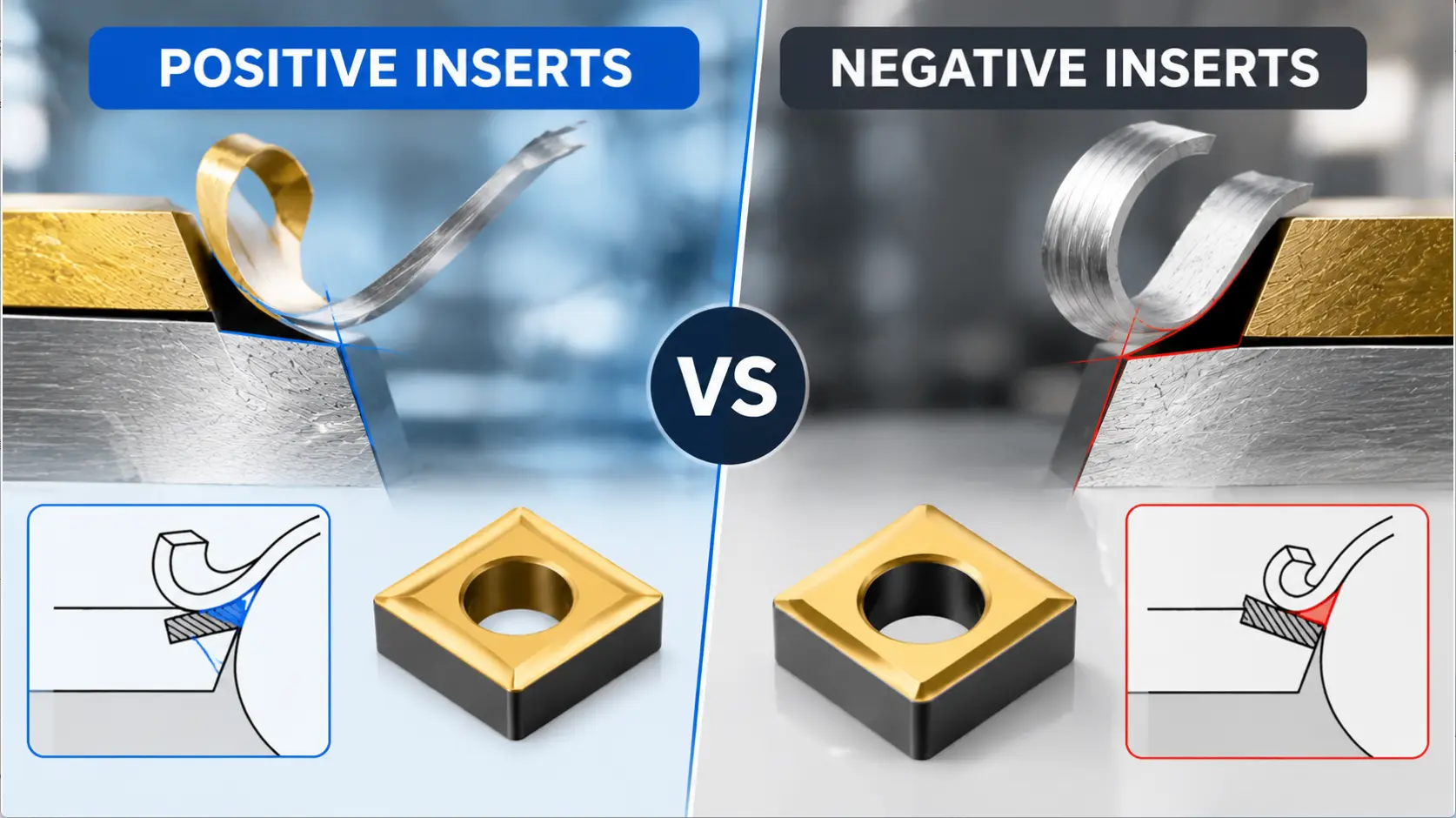
Ordering a positive insert for a negative holder, or the reverse, creates a fit problem before the spindle starts. The names describe clearance geometry, yet buyers often read them as rake labels and overlook how the holder changes cutting force and edge support.
The tradeoff is edge strength versus cutting pressure. Negative inserts usually favor rigid, heavier cuts and more usable edges. Positive inserts usually cut more freely on parts prone to vibration. Checking holder angle, matching the insert to the turning operation, and verifying replacement compatibility prevents an expensive order that cannot run.
Key Takeaways
- Geometry Difference: Negative inserts have zero clearance, while positive inserts have side clearance molded or ground below the edge.
- Force Tradeoff: Positive geometry usually lowers cutting force and deflection, helping boring bars, slender shafts, and thin walls.
- Edge Economy: Negative inserts often use both faces, but stronger geometry only pays when the setup can carry higher forces.
- Holder Compatibility: Clearance angle, pocket tilt, clamping method, size, and thickness must match before changing insert families.
What Is the Difference Between Positive and Negative Turning Inserts?
A negative turning insert has a 0° clearance angle. Its flank stands at 90° to the top and bottom faces, leaving a thick carbide wedge behind the cutting edge. A positive insert has clearance below the edge, commonly 7° or 11° in general turning products. The relieved flank prevents rubbing without requiring the same pocket tilt used for a negative insert. Mitsubishi Materials identifies an insert with the ISO clearance symbol N as negative and inserts with a clearance angle other than 0° as positive (Insert Turning Identification Code, Mitsubishi Materials).
This geometry changes how the insert is used. Negative inserts can often carry chipbreakers on both faces, which can provide more usable edges per insert. Their thick wedge supports roughing and higher mechanical loads, but it usually creates higher cutting forces. Positive inserts are normally single sided. Their relieved flank allows a sharper cutting action with lower force, making them common for internal turning, slender shafts, thin walls, and machines with limited rigidity. These descriptions identify the insert style. The actual rake at the cutting edge also depends on the chipbreaker and toolholder pocket.
Insert Geometry, Holder Angle, and ISO Codes
The second character in an ISO turning insert designation identifies clearance angle. In CNMG, the N means 0° clearance. In CCMT, the second C means 7° clearance. The first character still identifies shape, so both examples use an 80° rhombic shape even though their flank geometry and holders differ. Effective rake is a separate result of insert top geometry and the angle at which the holder presents the insert to the workpiece (Cutting Tool Geometries, SME).
| ISO clearance symbol | Clearance angle | Insert family | Typical purchasing meaning |
|---|---|---|---|
| N | 0° | Negative | Usually requires an inclined pocket and may allow use of both faces |
| A | 3° | Positive | Small relief for specialized holders and applications |
| B | 5° | Positive | Moderate relief used in selected turning insert families |
| C | 7° | Positive | Common positive style for general turning and boring |
| P | 11° | Positive | More clearance for small bores, profiling, and light cutting |
| D | 15° | Positive | Higher relief for access and specialized profiles |
| E | 20° | Positive | High clearance for specialized cutting conditions |
Do not treat the clearance letter as a complete compatibility code. CNMG120408 and CCMT120408 may appear similar because several size fields match, but they require different insert seats and often different clamping arrangements. The negative insert needs pocket inclination to create working clearance. The positive insert already has flank relief and normally sits differently. Confirm the complete holder code, insert thickness, inscribed circle, hole style, tolerance class, nose radius, and chipbreaker before selecting an indexable insert.
How to Choose Positive vs. Negative Inserts by Operation
Choose from the part and setup before comparing price per insert. A rigid external turning setup can use the edge strength and edge count of a negative insert. A long boring bar or thin component usually benefits more from the lower force of a positive insert. Sandvik Coromant recommends positive geometry to reduce cutting force and tool deflection in vibration sensitive turning (Turning Application Guide, Sandvik Coromant).
| Operation or condition | Usual starting point | Reason | Main check |
|---|---|---|---|
| Stable external roughing | Negative | Thick edge section supports heavier mechanical load | Machine power, holder rigidity, and chip control |
| Interrupted external turning | Negative with a suitable tough grade | Strong wedge can resist impact when the setup is rigid | Interruption severity and edge preparation |
| General external finishing | Application dependent | Negative inserts offer edge economy; positive inserts reduce force | Required finish, depth of cut, and part rigidity |
| Small diameter boring | Positive | Flank clearance and lower force suit limited space | Minimum bore, bar diameter, and overhang |
| Long overhang boring | Positive | Lower tangential force can reduce bar deflection | Nose radius, lead angle, and damping |
| Slender shaft turning | Positive | Free cutting geometry reduces radial load on the part | Work support and depth of cut |
| Thin wall machining | Positive | Lower cutting pressure reduces distortion risk | Clamping force, wall thickness, and edge sharpness |
| Low power machine | Positive | Lower cutting force reduces spindle load | Feed range and chip formation |
| High edge count priority | Negative | Double sided designs may provide more usable edges | Whether every edge can run reliably in the actual cut |
Positive geometry does not automatically cure vibration. Seco notes that positive rake can reduce tangential force, while a sharp edge may suffer impact damage and uneven wear if the load changes suddenly (Overcome the Ongoing Challenges of Long Reach Machining, Seco Tools). A negative insert can also use a positive chipbreaker to create freer cutting action at the edge. After choosing the insert family, verify the grade, edge preparation, chipbreaker range, feed, depth of cut, and cutting speed for the specific workpiece.
Replacement and Purchasing Checks Before Changing Insert Type
Changing from a negative insert to a positive insert usually requires a different holder. The reverse change does too. Even when the insert shape and nominal size look close, clearance angle changes the pocket, support surface, and cutting edge position. A mismatched insert may not seat securely or place the tip at the intended center height.
- Record the complete insert designation, including grade and chipbreaker suffix.
- Record the complete holder or boring bar code and its hand direction.
- Confirm insert shape, clearance angle, tolerance class, size, thickness, and nose radius.
- Check the hole, countersink, clamp, lever, or screw arrangement.
- State whether the operation is external turning, facing, profiling, or boring.
- Provide the workpiece material, hardness, cutting speed, feed, and depth of cut.
- Note coolant delivery, overhang, part support, and machine power.
- Add photos of chipping, flank wear, poor finish, chatter, or chip control problems.
- Give the trial quantity and expected production quantity separately.
The insert code should lead the replacement search, but operating details determine whether the same geometry and grade should be purchased again. Send the insert code, holder code, cutting conditions, failure details, photos, and required quantity through the CarbideMatch contact page. The review can then cover holder compatibility, material matching, availability, sample options, and quotation details without assuming that every insert with the same basic shape is interchangeable.
Frequently Asked Questions
Is a Positive Insert the Same as a Positive Rake Tool?
No. A positive insert has a clearance angle below the cutting edge, while positive rake describes the orientation of the cutting face during the cut. The holder inclination and chipbreaker geometry help determine the effective rake. A negative insert can therefore have a chipbreaker that creates a positive cutting action at the edge.
Are Negative Turning Inserts Always Double-Sided?
No. Zero clearance makes a double sided design possible, but the actual number of usable faces depends on the insert construction and chipbreaker. Some negative inserts are single sided for a specific geometry or application. Check the manufacturer’s edge count rather than assuming both faces can cut.
Which Insert Type Produces Lower Cutting Forces?
Positive inserts usually produce lower cutting forces. Their flank relief and sharper cutting geometry reduce pressure on the tool and workpiece. This is useful for small boring bars, long overhangs, slender shafts, thin walls, and machines with limited power. The nose radius, chipbreaker, edge hone, and cutting data still affect the final load.
Which Insert Type Has the Stronger Cutting Edge?
Negative inserts usually have the stronger carbide section because their 0° clearance creates a thick 90° wedge. That geometry commonly suits roughing and mechanically demanding cuts. Edge strength also depends on insert shape, nose angle, edge preparation, carbide grade, coating, feed, and the severity of interruption.
Can a CCMT Insert Replace a CNMG Insert?
No. A CCMT insert has 7° clearance, while a CNMG insert has 0° clearance. Their holders use different pocket geometry and support. Matching numbers later in the designation do not cancel that difference. Use the complete insert and holder codes to find a compatible replacement.
Are Negative Inserts Always Cheaper Per Cutting Edge?
No. A double sided negative insert may offer more usable edges, which can lower the purchase cost per indexed edge. The saving disappears when high cutting force, vibration, poor chip control, or access prevents reliable use of those edges. Compare cost per completed part, not only the number of corners on the insert.
What Information Is Needed to Match a Replacement Insert?
Start with clear photographs of the insert, its package, and the holder pocket.
- Complete insert designation, grade, and chipbreaker
- Complete holder or boring bar code
- Workpiece material and hardness
- Operation and required surface finish
- Cutting speed, feed, and depth of cut
- Coolant method, overhang, and setup stability
- Current wear or failure and required quantity
These details show whether the current insert is positive or negative and whether a change in holder, geometry, grade, or cutting data is needed.
Conclusion
You can now explain what is the difference between positive and negative turning inserts without confusing clearance angle with rake. Negative inserts provide a thicker edge section and often more usable cutting edges. Positive inserts reduce cutting force and suit boring, slender parts, and light machines. The correct choice still depends on holder fit, setup rigidity, operation, and failure mode.
Send CarbideMatch your insert code, holder code, workpiece material, cutting data, coolant method, failure photos, and required quantity. You can request a review of compatibility, grade selection, availability, sample options, and quotation details before ordering a replacement or changing insert families.