

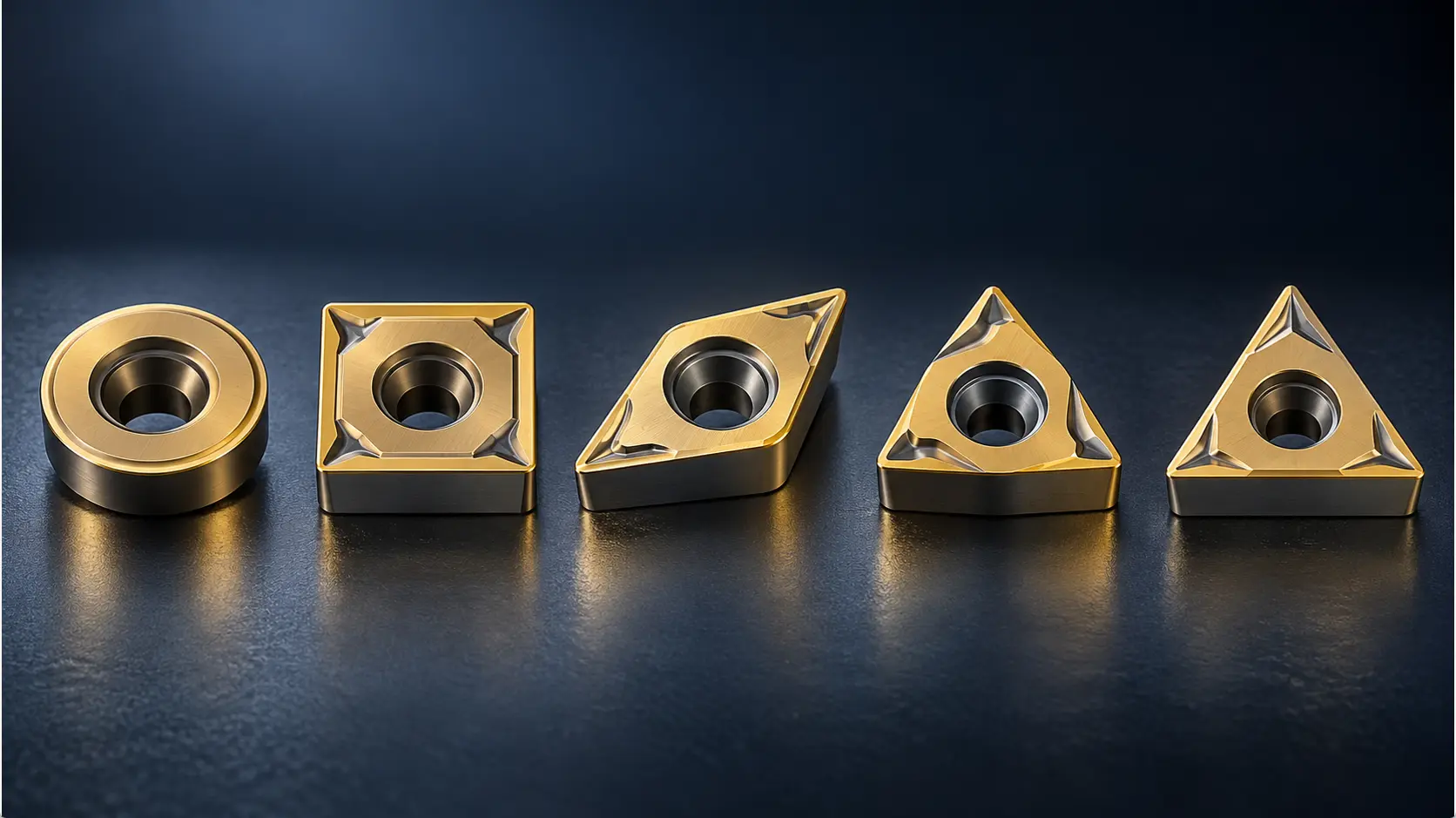
Choosing the strongest insert by appearance can lead to a holder that cannot reach the feature or a cutting edge your machine cannot support. The short answer to what is the strongest carbide insert shape? is round, but that answer needs operating limits.
Your purchase should balance the five strongest insert shapes with the job’s required access and your machine’s power. Round, square, C, W, and T shapes support the edge differently. Mitsubishi Materials, ISCAR, and shop-floor discussions also show why holder fit and cutting force matter.
Key Takeaways
- Strongest Edge: Round inserts provide continuous edge support, making them the strongest common shape for rough and interrupted cuts.
- Strong Rougher: Square inserts combine a supported 90-degree corner with up to eight edges on double-sided negative designs.
- Balanced Choice: C-shaped inserts provide strong 80-degree corners, stable seating, and useful turning and facing access.
- Machine Fit: Small or flexible lathes may cut better with positive inserts despite their lower theoretical edge strength.
What Is the Strongest Carbide Insert Shape?
The round R insert has the strongest cutting edge among common turning insert shapes. It has no isolated corner that concentrates the cutting load. The curved edge provides continuous support, which helps in heavy roughing, interrupted cuts, cast iron skin, and work with surface scale. Mitsubishi Materials directly identifies the round insert as the strongest cutting edge and lists interrupted cutting among its suitable uses (Insert Geometries, Mitsubishi Materials).
That does not make a round insert the best choice for every lathe. Its long contact area can produce wide chips and high radial force. Thin walls, slender shafts, long boring bars, and light machines may vibrate before the round edge reaches its strength limit. A square or 80-degree insert can be easier to apply when the job needs a shoulder, lower cutting force, or a smaller contact zone. Start with the required operation and machine capability, then use shape strength as one selection factor when reviewing carbide inserts.
Top 5 Strongest Carbide Insert Shapes Ranked
| Rank | Shape and code | Point angle | Relative edge strength | Common usable edges* | Machine demand | Best fit | Main limit |
|---|---|---|---|---|---|---|---|
| 1 | Round, R | Full radius | Highest | Variable by indexed position | High when much of the edge is engaged | Heavy roughing, interrupted cuts, scale, copy turning | High radial force and vibration risk |
| 2 | Square, S | 90° | Very high | Up to 8 | Medium to high | Rough turning and rough facing | Limited shoulder access |
| 3 | 80° diamond, C | 80° | High | Up to 4 working 80° corners, with some holders using the 100° corners | Medium to high for negative styles | General turning and facing | Less profile access than D or V shapes |
| 4 | 80° trigon, W | 80° | High | Up to 6 | Medium to high for negative styles | Medium turning with good edge economy | Shorter cutting edge and shallower cut than comparable C shapes |
| 5 | Triangle, T | 60° | Moderate | Up to 6 | Low to medium with positive styles | Turning, facing, boring, and basic profiling | Weaker corner than 80° and 90° shapes |
*Usable-edge counts depend on whether the insert is single-sided or double-sided and whether the holder can present a given corner correctly.
1. Round Insert (R)
A round insert ranks first because its edge has no sharp point. Load can move along the arc instead of concentrating at one corner. This makes the shape a strong choice for roughing through scale, intermittent contact, and uneven cast surfaces. ISCAR also recommends round or square shapes for demanding roughing with reinforced ceramic grades, along with a large corner radius and stable tool setup (IW7 Whisker Ceramic Grade, ISCAR). The same shape principle applies when comparing carbide insert support, although grade recommendations remain material-specific.
The curved edge has costs. More contact length raises cutting force and can make chips wider and harder to control. A round insert also creates a broad radial load as it enters the work. On a small lathe, a thin wall, or a long overhang, that load may cause chatter. Walter’s turning guidance places round inserts and larger corner radii toward the higher-vibration side of its selection chart for slender or long-overhang work (Technical Compendium Turning, Walter Tools).
2. Square Insert (S)
The square shape places substantial carbide behind its 90-degree corner. A double-sided negative square insert can offer eight cutting edges, which gives it both strength and good edge economy. It suits rough turning and rough facing on castings, forgings, and rough-sawn blanks. The toolholder must present the square at a lead angle, so the shape normally cannot turn straight into a 90-degree shoulder. Radial force can also be high. TechMet recommends a stable setup for this shape and notes its use in rough-facing work (Turning Insert Application Guide, TechMet).
3. 80° Diamond Insert (C)
The C shape gives a strong 80-degree working corner with better access than a square insert. It can turn an outside diameter and face the part with one holder, which explains why it is common on CNC and manual lathes. A CNMG-style insert also seats securely and has a long cutting edge. This combination suits medium and heavy work when the machine can support a negative insert.
Small-machine buyers should separate the shape from the complete geometry. CNMG and CCMT are both C-shaped, but they do not create the same cutting demand. A negative CNMG tool generally needs more power and rigidity. A positive CCMT edge cuts with lower force and can work better on a light lathe, even though its cross section has fewer usable sides. In the MIG Welding Forum discussion, owners of smaller machines repeatedly favored positive CCMT or DCMT systems over negative CNMG tooling for this reason (Best Carbide Insert Shape/Type?, MIG Welding Forum). That is field experience rather than a universal rule, but it identifies an important buying check.
4. 80° Trigon Insert (W)
The W shape presents an 80-degree working corner and normally provides six edges on a double-sided negative insert. That edge count can reduce cost per edge when the operation stays within the insert’s feed and depth limits. Compared with a similar C shape, a W insert has a shorter cutting edge and less pocket support. TechMet therefore places it in more moderate feeds and depths of cut than CNMG-style inserts. Forum users also raised concerns about rear clearance and chips becoming trapped near the work, while others liked WNMG as an economical general tool. The different results show why edge count alone should not decide the purchase.
5. Triangle Insert (T)
A triangular insert has a 60-degree point, so it carries less carbide behind the corner than the first four shapes. It still provides more edge support than a 55-degree D or 35-degree V insert. Negative triangular inserts may provide six edges, and the shape can handle turning, facing, boring, and basic profiling. TechMet also notes its stable seating in boring bars and the extra side clearance that helps reduce chip jamming.
Positive TCMT tools can be useful on low-power manual lathes because the edge cuts more freely than a heavy negative tool. The forum discussion included a small-lathe user who selected a TCMT holder after first identifying the actual holder and insert fit. That example also shows the limit of shape rankings: a lower-ranked positive triangle can perform better than a stronger negative shape when the machine cannot supply the needed force or rigidity.
Strongest Shape Versus Best Shape for the Job
The shape must reach the cut before its strength can help. A round or square insert may survive roughing well but cannot copy a tight contour like a D shape. A C insert handles many turning and facing jobs, while a T shape gives more clearance in a bore. Match the shape to the operation, then choose the strongest corner that can complete the required feature.
| Application | Better starting shapes | Why they fit | Watch for |
|---|---|---|---|
| Heavy continuous roughing | R, S, C | Strong edge support and substantial carbide behind the cut | Power, radial force, and chip control |
| Interrupted roughing | R, S | Round edge spreads impact; square corner has strong support | Grade toughness, entry, and setup rigidity |
| General outside turning | C, W | 80° corner balances strength and access | W has less cutting-edge length and pocket support |
| Facing | C, S, W | Holder presentation allows productive face cuts | Square shape cannot approach every shoulder |
| Turning to a square shoulder | C or a more pointed shape in the correct holder | Better trailing-side clearance than S or R | Holder lead angle and unused edge contact |
| Back turning and detailed profiles | D | 55° point reaches features that stronger shapes cannot | Lower point strength and fewer economical edges |
| General boring | T, C, D | Clearance and stable pocket options suit internal work | Bar overhang, bore size, and chip evacuation |
| Thin walls or slender shafts | Positive C, D, or T with a smaller nose radius | Lower radial force reduces deflection risk | Edge strength and minimum chip thickness |
| Light, low-power lathe | Positive C, D, or T | Free-cutting geometry needs less power | Avoid rubbing from feed or speed that is too low |
C-shaped inserts are a sensible starting point for many outside turning and facing jobs. D-shaped inserts give up point strength for profile access, back turning, and work near a shoulder. Triangular inserts can provide useful edge economy and clearance in boring. Shop experience in the forum also shows that an operator’s preferred general-purpose shape changes with the lathe, holder inventory, material, and usual work. Use an insert selection that fits the actual feature rather than buying solely from a strength chart.
Check Your Machine and Holder Before Buying
Many insert purchases fail before cutting begins because the buyer starts with the insert instead of the holder and machine. Shape is only the first character in an ISO designation. The remaining code covers clearance, tolerance, insert type, size, thickness, and nose radius. Manufacturer-specific suffixes then identify the grade and chipbreaker. Matching only the outline of the insert is not enough.
- Read the full holder code. Confirm its hand, insert shape, clearance class, size, and clamping method.
- Check the maximum shank size in the tool post, the available center-height adjustment, and the shortest practical overhang.
- Judge whether the lathe has enough spindle power, speed range, bearing condition, slide adjustment, and tool-post rigidity for the planned insert.
- Choose positive or negative geometry from the machine and cut. A positive edge lowers cutting force, while a double-sided negative insert can provide more edges and stronger support.
- List the actual operations. Outside turning, facing, shoulders, profiling, boring, back turning, chamfering, and parting do not require the same access.
- Match the carbide grade, chipbreaker, nose radius, edge preparation, feed, and depth range to the workpiece material and expected load.
- Before buying a holder, confirm replacement-insert availability, package quantity, and whether other holders can use the same insert size.
Center height deserves a physical check. An insert set too high or low may scrape instead of cutting. Long projection, loose gibs, or a flexible tool post can make a sound insert chatter. The forum also shows why buyers with several holders often standardize on one available insert size to reduce stock and avoid buying many partly used boxes. If the holder code or insert seat is unclear, send the codes and application details to CarbideMatch before ordering a different shape.
HSS remains useful for light cuts, slow spindles, and work that requires frequent custom grinding. Carbide can remove material faster and provides repeatable replacement edges, but it needs enough speed and feed to cut rather than rub. The decision should reflect the machine, production needs, and operator setup, not a simple claim that either material is always better.
Frequently Asked Questions
Are Round Carbide Inserts Always the Strongest?
They usually have the strongest edge support from shape alone. Actual resistance to chipping also depends on carbide grade, insert thickness, edge preparation, clamping, tool engagement, and setup rigidity. A round insert can still fail through chatter or excessive cutting force.
Is a Square Insert Stronger Than a CNMG Insert?
The square insert’s 90-degree point normally has more support than the working 80-degree corner of a CNMG insert. A CNMG is more flexible for common outside turning and facing. The holder, lead angle, grade, and edge preparation can change the result in a specific cut.
Is CCMT Stronger Than DCMT?
The CCMT’s 80-degree point is stronger than the DCMT’s 55-degree point when the other design factors are similar. DCMT gives better access for profiles, back turning, and work close to a shoulder. They use different pockets and should not be treated as interchangeable.
Are CNMG and WNMG Inserts Equally Strong?
Both use an 80-degree working corner. CNMG usually provides a longer cutting edge and more secure pocket support for deeper or heavier work. WNMG normally provides six usable edges, which can improve edge economy in moderate cutting conditions.
Which Insert Shape Is Best for a Small Lathe?
No single shape fits every small lathe. Positive CCMT, DCMT, DCGT, or TCMT tooling is often a better starting point because it reduces cutting force. Use a suitable nose radius, short overhang, correct center height, and a holder sized for the tool post.
Does a Larger Nose Radius Make an Insert Stronger?
A larger nose radius adds edge support and can allow higher feed when the setup is stable. It also increases radial force. A smaller radius may work better on slender shafts, thin walls, long boring bars, or light machines that tend to vibrate.
Can I Change Insert Shape Without Changing the Holder?
Assume no unless the holder manufacturer documents the combination. Shape, size, thickness, clearance angle, center hole, countersink, pocket, shim, screw, and clamp must match. Check the full holder and insert designations before ordering a substitute.
Conclusion
Round inserts rank first for pure cutting-edge strength, followed by square, C, W, and T shapes. That order does not replace application checks. Machine power, rigidity, holder fit, cutting force, usable edges, and access to the feature determine which shape will produce stable parts without chatter or wasted tooling.
Send your holder or insert code, workpiece material and hardness, operation, machine details, cutting data, failure photos, and required quantity to CarbideMatch. You can have shape, grade, compatibility, availability, sample options, and quotation details reviewed before committing to a new holder and insert system for your actual production job with confidence.